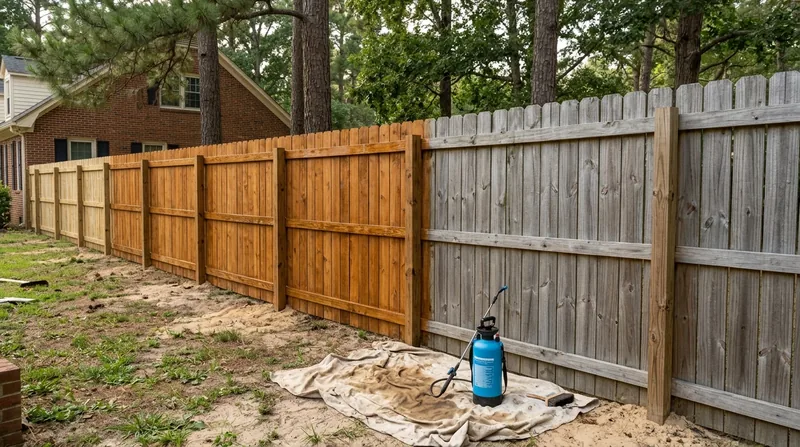




Fayetteville sits on the Fall Line where the sandy Sandhills roll into the flat Coastal Plain, and that mix of loose sand, red-clay pockets and humid river-bottom air is hard on wood. A six-foot treated-pine privacy fence in Haymount or Massey Hill takes full Carolina sun on one side and damp ground at the post line, and untreated boards go gray and fuzzy within two summers. Fence staining in Fayetteville is the cheapest way to slow that down: clean the mill glaze and gray wood off, brighten the surface, and put a UV-blocking stain back into the grain. We do that work on cedar and pressure-treated pine, and we tell you straight when a fence is past saving. If the rails are sound but the posts are soft, start with fence post repair before you spend a dollar on stain.
Why Fayetteville Wood Fences Fade, Gray and Rot So Fast
The failure mode here is not cold. It is UV and moisture working together. Summer afternoons push the index past 95 with heavy humidity, and the same sun that fades a vinyl-sided subdivision home in Cliffdale bakes the south and west faces of a pine fence until the lignin breaks down and the board turns silver. Add pine pollen in March, crape myrtle and dogwood litter, and the occasional tropical-system wind that drops a loblolly limb across a fence line, and bare wood never gets a break.
- Unsealed pine boards in full sun gray out in 18 to 24 months and start checking at the ends.
- Posts set in the loose sandy soil north and west of town wick moisture at the ground line, which is where rot starts.
- Heavier red-clay pockets near Cross Creek hold water against the bottom rail and speed up decay.
- Mill glaze on new cedar and pine keeps stain from penetrating, so a brand-new fence needs a wait or a light wash first.
- Hurricane-season wind and summer thunderstorms crack rails and open joints where water gets in.
A proper clean, brighten and seal cycle buys years of service from boards that still have meat on them, and it costs far less than a new fence line.
Key info: A cedar fence in Bonnie Doone that has gone silver but still feels solid under a screwdriver is a good candidate for restoration. A pine fence in Westarea with soft posts and delaminating rails is not. We check both before quoting, because staining a failing fence wastes your money.
For background on how wood preservatives and finishes are regulated and labeled in the U.S., the EPA pesticide registration program explains what those product labels actually mean.
How We Restore a Fayetteville Fence, Step by Step
We do not pressure-wash a fence and call it stained. High pressure fuzzes the grain and drives water into joints, and on a 1950s brick ranch lot in Massey Hill that water sits against the rails for days. Our sequence is slower and it is what makes the finish last through a Carolina summer.
- We walk the fence line and probe posts at the ground line to confirm the wood is worth restoring.
- We wash with a wood cleaner at low pressure to strip pollen, mildew and gray fiber without raising the grain.
- We apply a brightener to even out the color, especially where one side has baked in sun and the other stayed shaded.
- We let the wood dry to the moisture level the stain manufacturer calls for, which in humid Fayetteville weather can take a couple of days.
- We mask hardware, gates and any aluminum or vinyl panels that should not take overspray.
- We apply the stain by spray and back-brush it into the pickets, rails and posts so it penetrates instead of sitting on top.
- We inspect the gate swings and self-latching hardware and note any boards that need replacing before the next coat.
On a typical half-acre lot in Stedman or Parkton, the whole cycle runs two to three days depending on weather and square footage.
Key info: A homeowner in Hope Mills had a five-year-old pine privacy fence that had never been sealed. The south run was silver and checked, but the north run still had color. We cleaned and brightened the whole line, then put a transparent stain on the sound boards and replaced eleven pickets on the sun side. The fence is still standing straight years later, and the cost was a fraction of a new line.
If the wash turns up posts that are soft at the soil line, we fold that into the same visit rather than leaving you with a stained fence on rotten legs.
Stain, Paint or Seal: Matching the Finish to the Fence
Homeowners ask about fence painting and fence sealing as if they were the same job. They are not, and the right call depends on the wood, the look you want and how much maintenance you will tolerate. Here is how we compare the options on Fayetteville fences.
| Approach | Description | Best for |
|---|---|---|
| Transparent oil stain | Shows the grain and natural cedar or pine color while blocking UV. | Cedar privacy fence in Haymount where the wood is the point. |
| Semi-transparent stain | Adds tone and hides some graying while still letting grain read through. | Older pine fences with uneven color across the line. |
| Solid-color stain | Heavy pigment film that hides grain and checks, needs recoating sooner. | Board-on-board fence where a uniform look matters. |
| Clear water-repellent sealer | No color, just moisture and UV protection, shortest service life. | New cedar that you want to weather naturally. |
| Paint | Opaque coating, cracks and peels in humidity, hardest to touch up. | Smooth-milled pickets where a specific color is required. |
Whatever finish you choose, the prep work is what decides how long it lasts in this climate.
Fence Staining and Restoration Cost in Fayetteville: What Moves the Number
Most residential restoration jobs here start around $950 for a typical backyard privacy line, and the number climbs from there. Fence staining cost is driven by square footage, how far gone the wood is, and how much prep the surface needs before a brush touches it. A fence under pine shade in Gray's Creek with heavy mildew takes more washing than a sun-bleached line in Spring Lake.
- Linear footage and fence height set the base, since a six-foot privacy line has far more surface than a four-foot picket.
- Condition drives prep time: gray, mildewed or previously painted wood needs more work than sound bare boards.
- Cedar and clear pine take stain differently than rough-sawn treated pine, and that changes how much product the job eats.
- Access matters, because a fence line crowded by sheds, HVAC units or tight gate openings slows the crew down.
- Repairs found during prep, like split pickets or soft bottom rails, get quoted separately before we proceed.
We recommend getting two or three estimates so you can compare what is actually included, not just the bottom line. Some quotes skip the brightening step or the back-brushing, and that shows up two summers later. Our full pricing overview lays out how we build a number.
Choosing a Fence Staining Contractor Near Me in Fayetteville
Staining looks simple until you see a fence with lap marks, overspray on a vinyl privacy panel, or stain peeling off because the wood was wet when it went down. Ask questions before you hire, and expect clear answers.
- Ask for a certificate of insurance showing general liability and workers' compensation cover, and confirm it before work starts.
- Get two or three written estimates that spell out washing, brightening, stain brand and number of coats.
- Ask for local references on fences similar in age and wood species to yours.
- Check HOA architectural standards in master-planned communities, since some govern fence color and finish.
- Confirm the crew will mask hardware, gates and adjacent surfaces before any spray goes on.
A contractor who hesitates on any of these is telling you something. You can reach us through the contact page to set up a walk-through.
If your fence line runs along a pool, note that pool barrier requirements are set by state law and local code, and final determination rests with the authority having jurisdiction.
For homeowners in the 28303 ZIP, our Fayetteville 28303 service page covers the local details, and the wood and privacy fence page explains what we look for on new installations.
Fence Staining & Restoration in Fayetteville: Pricing Guide
| Service | Price | Details |
|---|---|---|
| Basic clean, brighten and seal | Starting at $950 | Up to roughly 150 linear feet of sound six-foot privacy fence, including wash, brightener and one coat of stain. |
| Full restoration with repairs | Starting at $1,450 | Adds replacement of split pickets and bottom rails found during prep, priced by the board before work begins. |
| Large or heavily weathered line | On estimate | Long runs, heavy mildew or previously painted wood need an on-site look to price prep and product accurately. |
| Travel | Included | In Fayetteville and surrounding areas, no separate call-out or mileage fee. |
| Estimate | Free | Response within 24h at (910) 900-5114, no obligation to book. |
Indicative pricing, the exact cost depends on square footage, finish, and site access. Free personalized estimate within 24h at (910) 900-5114.


